
Last Message is a web-based ARG detective game developed through an AI-assisted workflow using Claude Code and ChatGPT-driven characters. The project explores how digital traces, such as deleted messages, broken links, account activity, and fragmented chat histories, can become the main material of storytelling. Instead of guiding players through a fixed linear plot, the game invites them to investigate a mysterious death by reading scattered digital evidence, interacting with AI-powered NPCs, and reconstructing the story through their own interpretation.
INSPIRATION
From Real Events to Fictional Investigation
The project was inspired by real-world online rumors and digital mystery cases, especially the media discussion around the “Blue Whale Challenge.” Rather than recreating the event directly, Last Message uses it as a reference for building an atmosphere of uncertainty, coercion, and unstable truth. I was also interested in how detective games and ARGs use fragmented information to create immersion. However, many existing mystery games rely heavily on fixed keywords and rigid puzzle structures. My goal was to create a more open investigative experience where players could move through the interface, follow traces, and form their own conclusions.
RESEARCH PROCESS
Test 01: Trash Trace Inference
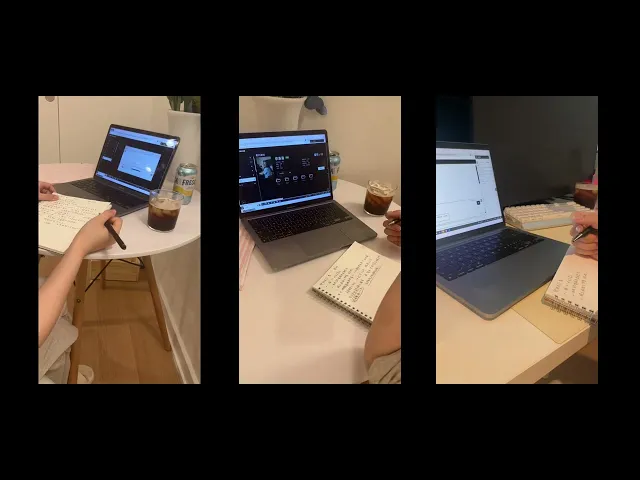
The first test explored whether traces could help people reconstruct a person or a scene. I showed participants images of decontextualized trash and everyday leftovers, then asked them to infer the owner’s identity, lifestyle, and emotional state. The results showed that people naturally create stories from very limited evidence. However, their interpretations were often different, showing that traces are powerful but also unstable and easy to misread.
Part 1: Based on the following four images, analyze the possible scenarios in which this trash bin might appear.

Part 2: Based on the information provided in the picture, analyze what kind of person the owner of the trash can might be (for example: gender, occupation, family situation, mood, etc.).

Test 02: Visual Detective Experiment
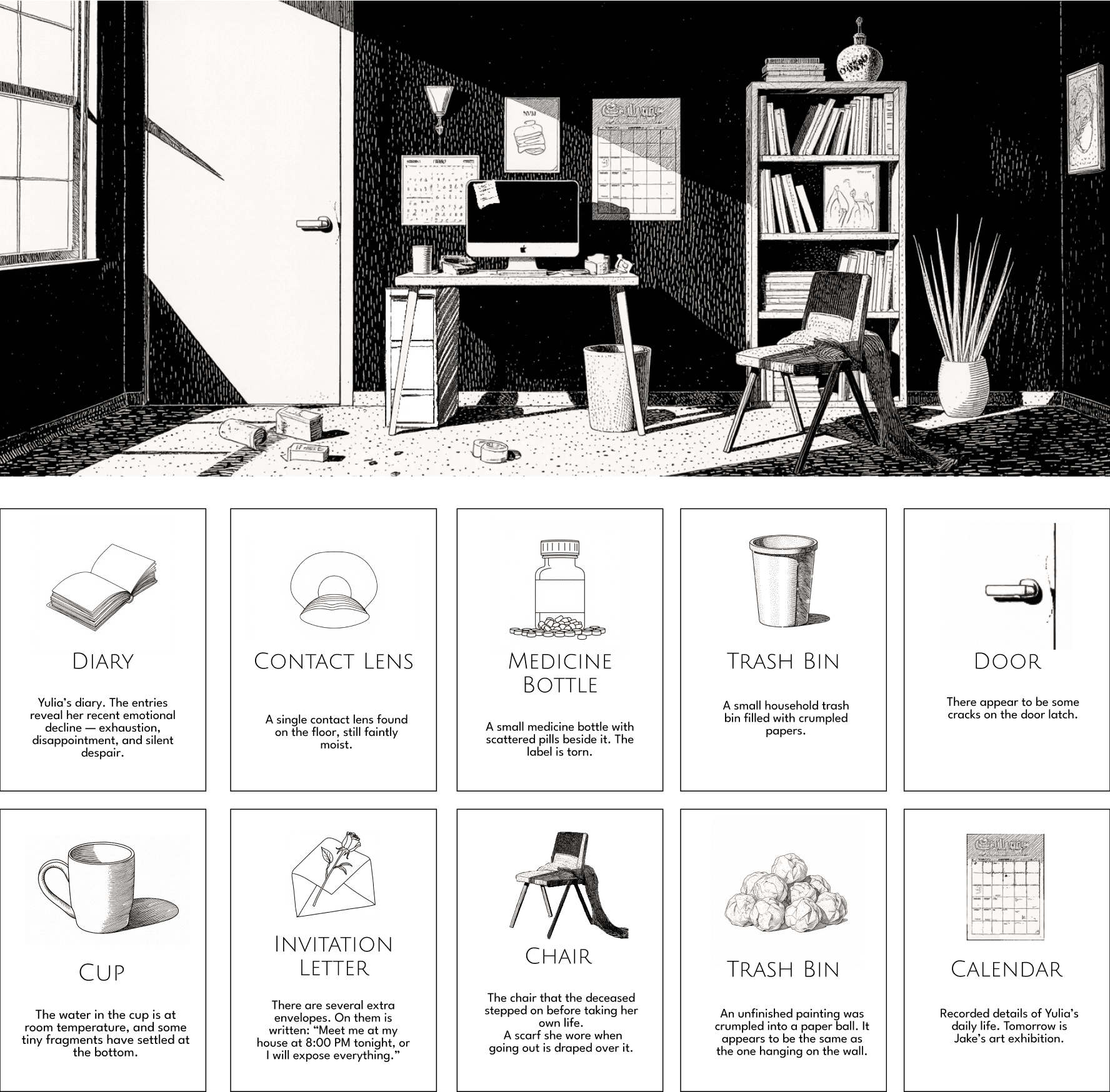
The second test focused on how players interact with visual evidence. I created a detective-like scene where participants could inspect details such as phone notifications, torn papers, and discarded objects. The base image of the scene was generated with AI, while the detailed evidence, clue objects, and interactive visual elements were drawn and added manually by me. This process allowed me to quickly build an atmospheric environment while still controlling the narrative details that guided the player’s investigation. Instead of reading the scene in a fixed order, participants moved between clues in their own way. This test helped me decide that an ARG format was more suitable than a linear story, because it could support non-linear investigation and fragmented reading.
GAME ITERATION
Cycle 01: Proof of Concept
The first playable prototype tested whether the basic idea of a web-based detective game could work. Players were asked to explore a simple interface and identify important clues. Feedback showed that the introduction contained too much text, the player’s role was unclear, and the motivation for investigation was not strong enough. In the next version, I reduced the amount of text, made the first page more visual, and redesigned it to feel closer to a police incident report.


Cycle 02: Technical Issues and AI Settings
The second iteration focused on technical feasibility and AI interaction. Through a technical interview, I realized that some interface decisions were based on my own experience with Chinese chat apps, such as WeChat, and might not be intuitive for American players. I also found that AI-assisted coding could create complex and sometimes inefficient code. For the AI NPCs, I began setting clearer boundaries to prevent players from breaking immersion by testing the AI outside the story.
Cycle 03: Logic and Branching
The third iteration focused on narrative depth, character dialogue, and branching logic. Feedback from a character designer and experienced mystery game player showed that the game needed more digital residues, richer visual details, and stronger emotional feedback near the ending. The AI characters also needed more flexible prompts, because repeated responses or weak keyword recognition could make them feel artificial.

Cycle 04: Final Refinement and Player Agency
The fourth iteration tested the game with eight players. Most players were able to understand the main storyline and identify the main suspect within around 35 minutes. However, only two players discovered the secret ending, which required deeper investigation of digital traces and more active interaction with AI NPCs. This showed that the main story was accessible, but hidden layers still needed stronger guidance and rewards.
AI USAGE
Claude Code
as the Foundation of Web Development
Claude Code was used as the main development tool for building the entire web-based game structure. It supported the construction of the interface, navigation logic, chat windows, clue pages, and branching interactions. Since Last Message relies on a multi-page investigative experience, Claude Code helped me quickly prototype different interaction flows and turn my design ideas into a functional web system. Throughout the process, I used natural language to describe the gameplay logic, then refined the generated code through testing, debugging, and visual adjustment. In this way, Claude Code became the technical foundation that allowed the project to move from a narrative concept into a playable web experience.
AI-Driven Characters
The characters in Last Message were powered by the ChatGPT API to create real-time NPC interactions inside the chat interface. Instead of using only pre-written dialogue, I designed each character with a specific background, personality, knowledge boundary, and emotional tone. When players typed questions, the system sent their input to ChatGPT together with a rule-based prompt that defined what the character could know, how they should respond, and what information they were not allowed to reveal. This allowed the NPCs to feel more alive and reactive while still staying within the mystery’s narrative structure. To prevent AI hallucination or off-topic responses, I added strict prompt rules and narrative constraints, so the characters would remain in-character and support the investigation without breaking the story world.


UI/UX & VISUAL DESIGN
From High-Fidelity Prototype to Functional Web Experience
The UI/UX design of Last Message was built around the feeling of entering a hidden digital archive. Since the game takes place inside a secret chat website, the interface needed to feel familiar enough for players to understand, but also unfamiliar enough to create tension. I used a dark, low-saturation visual style with subtle contrast, minimal decoration, and layered information panels to create an atmosphere of secrecy, surveillance, and investigation. The overall design language avoids dramatic horror visuals and instead focuses on quiet unease, digital absence, and the feeling of searching through something that was not meant to be seen.
The page structure was designed to support non-linear exploration. Instead of presenting the story as one continuous text, the website is divided into chat rooms, profile pages, clue pages, system messages, and hidden interaction points. Players can move between different pages like opening drawers of information, gradually collecting fragments from different parts of the interface. This structure allows the UI itself to become part of the storytelling: navigation, missing content, broken links, and locked sections all function as narrative clues.
Visual System
The second iteration focused on technical feasibility and AI interaction. Through a technical interview, I realized that some interface decisions were based on my own experience with Chinese chat apps, such as WeChat, and might not be intuitive for American players. I also found that AI-assisted coding could create complex and sometimes inefficient code. For the AI NPCs, I began setting clearer boundaries to prevent players from breaking immersion by testing the AI outside the story.

High-Fidelity Design vs. Claude-Built Final Website
Before building the final website, I created high-fidelity interface designs to define the visual direction, layout system, and interaction flow. These designs served as the blueprint for the final web version. During development, Claude Code helped translate the high-fidelity prototype into a functional website, including page navigation, interactive states, chat logic, and clue-based progression. The final version kept the main visual atmosphere and interface structure from the prototype, while some details were adjusted during implementation to improve usability, loading performance, and interaction clarity.
